

Rates
Your pricing, expressed as rules rather than kept in a spreadsheet. Base prices per period and season, rates computed from other rates so one change ripples through, early bird discounts, late check-out, the dog, tourist tax and VAT itemised correctly on every invoice. Set it up once and every booking (desk, website or channel) calculates itself.
- Live
- Included in the PMS
- On every plan
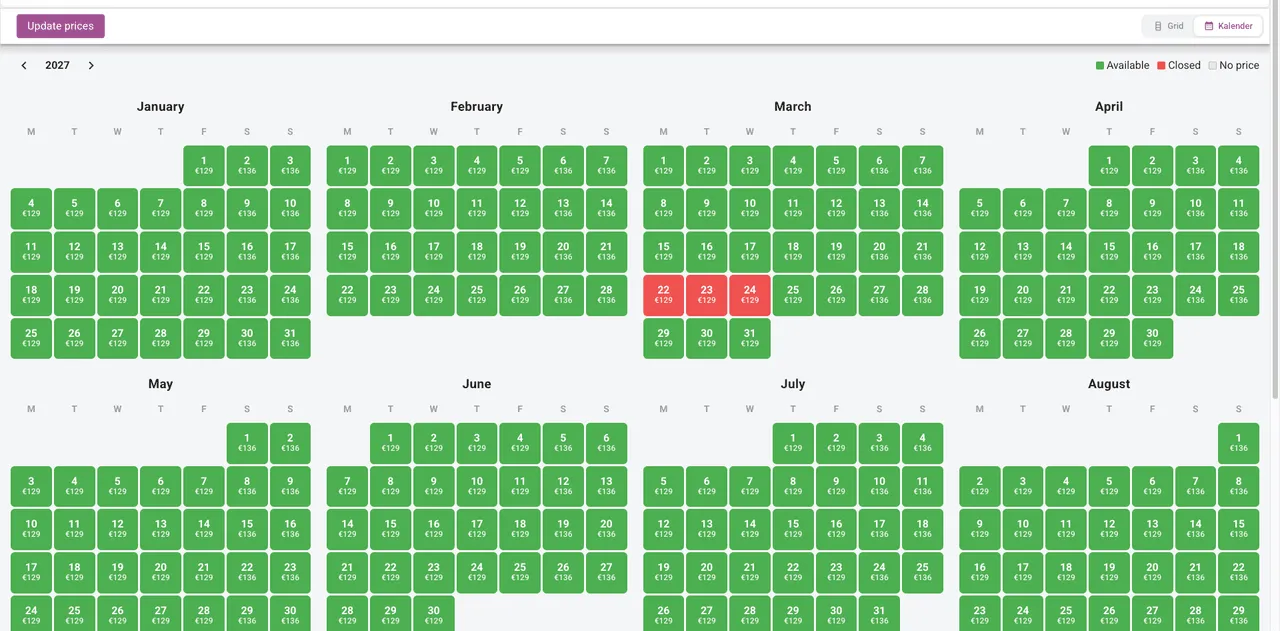
Price the season, not each booking
- OncePer season, not per reservation
- ComputedRates derived from other rates
- VATItemised, per rate
From base price to the awkward exception
Periods and seasons
Prices per period, changed across periods in one pass rather than cell by cell. There is a quick-update route for the January afternoon when you are putting next season's numbers in, and a considered one for building a structure from scratch.
Discounts that drive behaviour
Early bird to pull bookings forward and fill your curve earlier, length-of-stay and period discounts to move the weeks you are thin on. Set as logic, so the guest sees the right price online without you running a promotion by hand.
Options and surcharges
The dog, the extra person, late check-out, the second car. Each one either a mandatory fee or something the guest chooses, which is the difference between a price a guest trusts and one they query at the desk.
Tax, correctly
VAT per rate and tourist tax per person per night, calculated and itemised. It matters most where a stay crosses a rate change or a guest is exempt, which is exactly where a spreadsheet gets it wrong.
A note on channels and per-person pricing
Some booking channels do not carry per-extra-guest pricing at all. Booking.com is the big one: it takes a rate for a room type and nothing about what a fifth person costs.
The practical rule is to set the rates you send to those channels for the accommodation's full occupancy: a four-person lodge priced for four. Otherwise the guest is quoted for two, arrives with four, and the difference is a conversation at your desk on their first afternoon.
Rates that exist only for one channel are the tool for this. Build them, connect them to that channel alone, and your own booking engine keeps the per-person pricing you actually prefer.
Frequently asked
Can I change all my prices for next season in one go?
Yes. There is a quick-update route built for exactly that, rather than editing period by period.
What is a computed rate?
A rate whose price is derived from another one: a percentage above your base, for instance. Change the base and everything built on it moves with it.
Can a rate be for the back office only?
Yes. Rate conditions include whether the rate is available to guests booking online, which is how a staff or agent rate stays off your website.
How is tourist tax handled?
As a tax in the calculation, per person per night, itemised on the invoice. Exemptions are handled on the reservation rather than by editing the price.
Can prices differ per channel?
Yes. Create rates that only one channel uses and connect those, which also lets you hold different availability there.